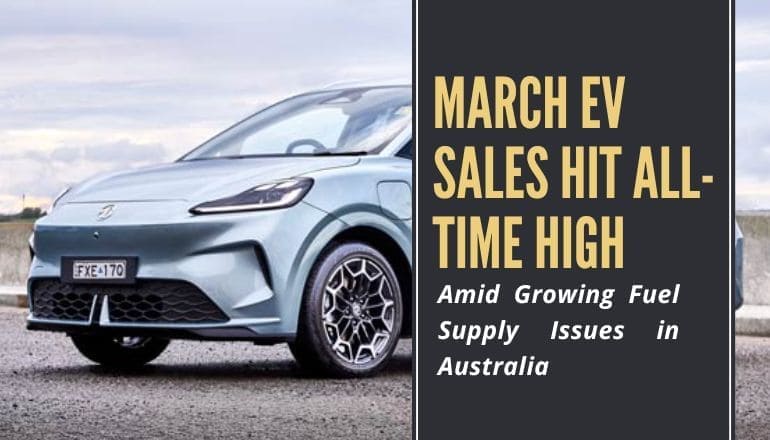
March EV Sales Hit All-Time High Amid Growing Fuel Supply Issues in Australia
The Electric Vehicle (EV) market of Australia reached an all-time high in sales in March. A total of 15,839 EVs were sold across Australia during this month. The March 2026 EV sales have been recorded for about 14.6% of all new vehicle sales. The sales percentage of EVs is approximately double that of March 2025 Electric car sales Australia, which were about 7.5%. The surge comes amid the rising fuel supply disruption due to the serious conflict in the Middle East.
A Closer Look At Current Fuel Prices
During March, fuel prices increased sharply due to both global supply shortages and local demand pressures. The national average has the petrol prices at a rate that is above $2 per litre, and the diesel increased to about $2.73 per litre. Premium vehicle fuel, such as the unleaded 95 petrol, jumped by 31.8% in late February and mid-March, and diesel increased at a rate of 40.1% during the same time.
A Quick Look at the Q1 2026 Car Sales
Since refuelling is increasingly becoming costly, individuals are moving towards EVs. Electric vehicle sales peaked in March with a record market share of 14.6%, resulting from 15,839 units sold.
Here’s a quick snapshot of the top sales of EVs in the Australian automobile market:
1. The EV market of Australia witnessed a rise of 88.9% sales from last year’s March sales.
2. It has also observed a rise of 42.3% sales from February.
3. In Q1 2026, the total new car sales Australia reached 282,862 units, which was down 2.6% year-on-year.
4. Tesla Model Y registered the strongest performance among all
5. EVs and finished third with sales of 2,818 units.
6. Toyota remained the top-selling brand with 44,490 units.
Meanwhile, petrol cars saw their sales drop by 20.8%, whereas diesel cars witnessed a reduction of 10.1%.
Latest EV Sales Record Levels
Despite the ongoing geopolitical tensions in the Middle Eastern countries, the Australian car market experienced consistent sales of popular vehicles. The top 10 EV, petrol, diesel and hybrid car selling best models of March 2026 in Australia are as follows:
| Vehicles | Sales Volume |
|---|---|
| Ford Ranger | 4452 |
| Toyota HiLux | 4167 |
| Tesla Model Y | 2818 |
| Hyundai Tucson | 2042 |
| GWM Haval Jolion | 2013 |
| Nissan X-Trail | 2438 |
| Mitsubishi Outlander | 2318 |
| Hyundai Kona | 2316 |
| Chery Tiggo 4 | 2258 |
| Isuzu D-Max | 2167 |
The huge transition to EVs is evident in the sales records of EVs in March. The top 5 selling EVs of March 2026 are:
| Vehicles | Sales Volume |
|---|---|
| Tesla Model Y | 2818 |
| BYD Sealion 7 | 1970 |
| Zeekr 7X | 679 |
| Geely EX5 | 606 |
| Kia EV5 | 587 |
Also Read: Top Selling EVs in Australia 2025: Tesla and BYD Lead the Market
What’s Driving the Fuel Shortage in Australia?
The ongoing disruption of crude oil transportation in the Middle East plays the most crucial role in the petrol and diesel disruption in Australia. The direct cause of the rise in fuel prices was the interruption of the supply of oil through the Strait of Hormuz, which accounts for one-fifth of all oil transportation globally. The dispute in Middle Eastern countries caused a significant reduction in oil tanker transportation in multiple nations, including Australia.
The demand for fossil fuels in Australia has also gone up during this Easter holiday season. The demand for diesel has been seen to increase by about 30% as compared to the previous year’s figures. Higher consumption during peak travel periods has contributed to faster drawdowns at service stations and increased pressure on distribution networks.
The Emergence of Hybrid Vehicles In Australia
Besides EVs, Aussies are also shifting towards hybrid vehicles. In March 2026, the sales of plug-in hybrid vehicles surged to 8,215 units with a rise of about 22.9% market share. Although hybrid vehicles use a petrol or diesel engine, their electrical systems can work with or without charging. Plug-in electric vehicles act like a pure EV until the battery is completely flat. This functionality makes these vehicles less dependent on fossil fuels and helps to beat the rising fuel costs.
Furthermore, there is a wide availability of hybrid car services across the nation. These vehicles include complex components of both petrol and battery-powered vehicles in Australia. The availability of car service is also driving car owners’ confidence to purchase plug-in hybrid models.
What’s Next?
The record rise in EV sales highlights a clear shift in the Australian car market as consumers respond to rising fuel costs. In this regard, ensuring the proper functionality is important to use EVs as your daily commute partner. To learn more about these vehicles, read the vehicle’s manual or simply book an appointment with regional experts like car servicing Perth. They can help you understand how EVs work as well as fix your car if there is any wear or tear.