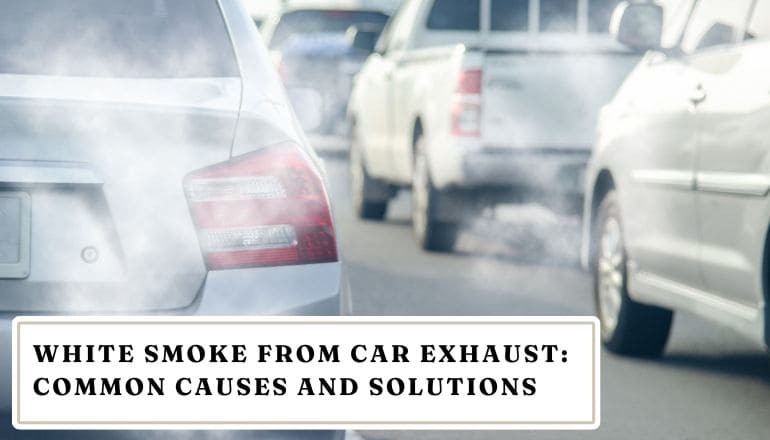
Seeing white smoke from your exhaust can be worrying, but it does not always mean your engine has a serious problem.
A small amount of light white smoke or vapour from the exhaust during a cold start can simply be condensation as the exhaust system warms up. However, thick or constant white smoke from the exhaust, especially after the engine has reached operating temperature, can indicate coolant entering the combustion chamber or another engine-related problem.
If your car is blowing white smoke from the exhaust, pay attention to when it happens, how long it lasts, whether it becomes worse when accelerating, and whether you notice other symptoms such as coolant loss, overheating, a sweet smell or poor engine performance.
In this guide, we’ll explain what causes white smoke from exhaust, what different types of white exhaust smoke can mean, whether a bad O2 sensor can cause white smoke, and when you should have your vehicle inspected by a professional mechanic.
What Does White Smoke from Exhaust Mean?
When you see white exhaust smoke, it usually means something is wrong with the engine or its components. White smoke can be caused by coolant or moisture entering the combustion chamber. When you see white smoke from the exhaust, it’s the time of car exhaust repair.
The color of the smoke is a good indicator of the type of problem. White smoke in a car indicates that the fuel consumes coolant or water vapor during combustion. This is a cause for concern as it could indicate an internal engine issue.
If you’re also noticing blue or black smoke, see our guide to different exhaust smoke colours to understand what each colour may indicate.
Is White Smoke From Exhaust Normal?
Sometimes, yes.
When an exhaust system is cold, moisture can collect inside it. Once the engine starts, hot exhaust gases heat the system and turn the moisture into visible water vapour.
This can look like white smoke from car exhaust, particularly during colder mornings or after the vehicle has been parked for several hours.
White vapour is more likely to be normal when:
It appears mainly during a cold start
The vapour is thin rather than thick
It gradually disappears as the engine warms up
There is no unusual smell
The engine runs normally
The coolant level remains stable
There is no overheating
If the white vapour disappears after warm-up and the vehicle has no other symptoms, condensation is usually a more likely explanation.
When Should You Be Concerned?
You should pay closer attention if the white smoke continues after the engine warms up, becomes thicker, appears repeatedly while driving, or is accompanied by coolant loss, overheating, a sweet smell or poor engine performance.
What Causes White Smoke From Exhaust?
Water vapor and condensation can cause vehicles to emit harmless white smoke; if you notice a thick cloud of white smoke when your vehicle starts, contact a car mechanic in Perth immediately.
There are several possible white smoke from exhaust causes. Some are harmless, while others require prompt mechanical inspection.
1. Normal Exhaust Condensation
The most harmless explanation is condensation.
Water is produced during normal combustion, and moisture can also collect inside a cold exhaust system. When the exhaust heats up, this moisture becomes visible as white vapour.
This type of light white smoke from exhaust should generally become less noticeable as the vehicle reaches normal operating temperature.
If it disappears quickly and there are no other symptoms, there may be no mechanical fault.
2. Coolant Entering the Combustion Chamber
One of the more serious causes of persistent white exhaust smoke is coolant entering the combustion chamber.
Coolant should normally remain within the vehicle’s cooling system. If there is an internal leak that allows coolant into a cylinder, the coolant can be burned during combustion and produce thick white exhaust smoke.
Possible causes include:
Head gasket failure
Damaged or cracked cylinder head
Cracked engine block
Certain internal coolant passage or sealing failures
You may also notice coolant loss, overheating, rough running or a sweet smell from the exhaust.
3. Head Gasket Failure
A failing or blown head gasket is one possible cause of constant white smoke from exhaust.
The head gasket helps seal the connection between the engine block and cylinder head while keeping combustion gases, coolant and engine oil separated.
If the gasket fails in a way that allows coolant to enter a cylinder, the coolant may burn during combustion and produce persistent white smoke.
Other possible symptoms include:
Coolant loss
Engine overheating
Rough engine operation
Misfires
Reduced engine performance
Sweet-smelling exhaust
Possible coolant contamination of engine oil
However, white smoke does not automatically mean your head gasket has failed. A proper mechanical inspection is required before confirming the cause.
4. Damaged or Cracked Cylinder Head
A damaged cylinder head can also allow coolant to enter the combustion chamber.
This may happen after severe overheating or because of damage to the engine components.
Possible symptoms include:
Persistent white exhaust smoke
Coolant loss
Engine overheating
Rough running
Loss of power
Sweet smell from the exhaust
Because these symptoms can overlap with a head gasket failure, a mechanic should diagnose the underlying problem rather than replacing parts based only on the smoke.
5. Cooling System Problems
Cooling-system problems can cause coolant loss or overheating and may contribute to more serious engine problems.
Components that may need inspection include:
Radiator
Coolant hoses
Water pump
Thermostat
Coolant reservoir
Cooling-system connections
It is important to understand that low coolant by itself does not automatically cause white exhaust smoke.
If coolant is disappearing, the source of the loss needs to be identified. If coolant is entering the combustion chamber, persistent white smoke may occur.
If your vehicle is losing coolant or overheating, a professional radiator and cooling system repair can help identify leaks and other cooling-system problems.
White exhaust smoke is not always caused by one specific component.
On some vehicles, particularly certain diesel or turbocharged engines, abnormal combustion or other engine-related faults can produce unusual exhaust smoke. The exact cause depends on the engine design and the symptoms present.
For this reason, it is better to diagnose the vehicle rather than immediately replacing an injector, sensor or other component.
7. Low Coolant Level
A head gasket or cylinder failure is usually the cause of white smoke coming from your tailpipe. If you fix both parts and still see smoke, it could be a leak somewhere else. Coolant can leak from damaged or corroded hoses or valves. A failing radiator or heater box may also cause it. When it trickles into the combustion chamber and burns along with fuel, this coolant produces white smoke.
White Smoke From Exhaust When Accelerating
If you are specifically searching for white smoke from exhaust when accelerating, the timing of the smoke is an important clue.
White smoke that becomes thick or persistent during acceleration can be concerning, particularly if it occurs together with:
Coolant loss
Engine overheating
Sweet-smelling exhaust
Rough running
Engine misfires
Reduced power
Constant white smoke after warm-up
These symptoms can occur when coolant is entering the combustion chamber, although other problems are also possible.
If your car is blowing white smoke from the exhaust when you accelerate, do not assume the problem is simply the exhaust system. The engine and cooling system should also be checked.
Why Is There White Smoke Coming Out of My Exhaust?
If you’re asking “why is there white smoke coming out of my exhaust?”, start by checking three things:
1. Does it disappear after the engine warms up?
If yes, condensation is more likely.
2. Is the smoke thick or constant?
If it continues after warm-up, it may indicate a mechanical or coolant-related problem.
3. Are there other symptoms?
Pay attention to:
Coolant level dropping
Engine overheating
Sweet exhaust smell
Rough idle
Misfiring
Reduced power
Warning lights
Poor engine performance
The combination of symptoms is more useful for diagnosis than smoke colour alone.
Light White Smoke From Exhaust vs Thick White Smoke
Understanding the difference between light vapour and persistent smoke can help you decide whether further inspection is necessary.
What You Notice
What It May Indicate
Light white vapour during cold start
Often normal condensation
Vapour disappears as engine warms
Usually less concerning
Thick white smoke after warm-up
Possible coolant or engine problem
Constant white smoke
Professional inspection recommended
White smoke + sweet smell
Possible coolant entering combustion
White smoke + coolant loss
Possible cooling-system or internal engine issue
White smoke + overheating
Potentially serious engine/cooling problem
White smoke when accelerating
Requires further investigation
Can a Bad O2 Sensor Cause White Smoke From Exhaust?
Usually, no. A faulty oxygen (O2) sensor is not a common direct cause of white smoke from the exhaust.
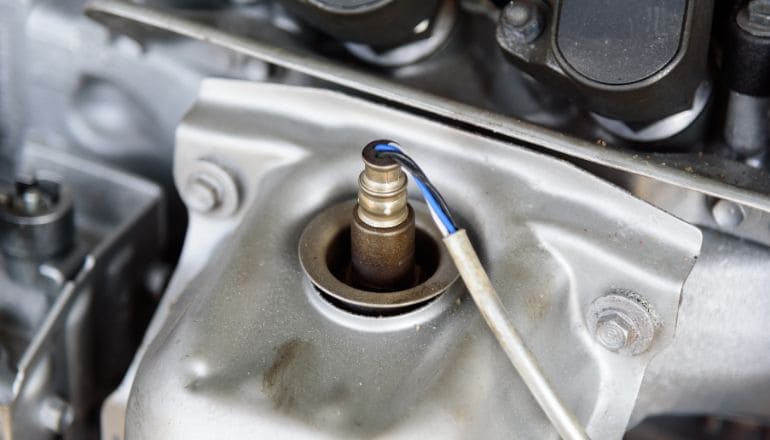
An O2 sensor monitors oxygen levels in the exhaust and helps the engine management system adjust the air-fuel mixture. A faulty sensor can contribute to problems such as poor fuel economy, rough running or a check-engine light.
However, white exhaust smoke is more commonly associated with condensation or coolant entering the combustion chamber.
If your car has white smoke and a check-engine light at the same time, the O2 sensor may be one of the components that needs to be checked during diagnosis, but it should not automatically be blamed for the smoke.
So, if you’re searching “can a bad O2 sensor cause white smoke from exhaust?”, the short answer is:
A bad O2 sensor usually does not directly cause white exhaust smoke. The underlying cause of the smoke should be diagnosed separately.
A professional car engine diagnostic service can help identify whether the problem involves the cooling system, engine combustion, sensors or another component.
What Engine Problems Can Cause White Smoke From the Exhaust?
If you’re searching for “engine problems from exhaust smoke” or “what causes white smoke from engine,” remember that white smoke is a symptom rather than a diagnosis.
Possible engine-related causes include:
Head gasket failure
Cracked or damaged cylinder head
Cracked engine blockInternal coolant leak
Certain engine sealing problems
Cooling-system problems that have resulted in overheating
Other combustion-related faults depending on the vehicle
A mechanic may need to inspect the cooling system, engine performance, fluid levels and relevant components to determine the actual cause.
If the smoke is persistent or accompanied by overheating, coolant loss or poor engine performance, an engine repair service may be required depending on the diagnosis.
White Smoke From Exhaust And A Sweet Smell
A sweet smell combined with persistent white exhaust smoke can be a warning sign that coolant is being burned inside the engine.
This becomes more concerning if you also notice:
Coolant loss
Engine overheating
Rough running
Misfires
Loss of power
Thick white smoke after warm-up
Do not rely on the smell alone to diagnose a coolant leak or head gasket problem. A professional inspection is needed to confirm the source.
If your car has white smoke and overheating at the same time, treat the situation seriously. Continuing to drive an overheating vehicle can increase the risk of further engine damage.
If your temperature gauge is moving into the hot range or a temperature warning appears:
Pull over somewhere safe.
Switch the engine off if it is overheating.
Allow the vehicle to cool.
Do not open a hot radiator or coolant reservoir.
Arrange professional assistance if the problem continues.
Never remove a radiator cap while the cooling system is hot. Pressurised coolant can cause serious burns.
Can I Drive With White Smoke From the Exhaust?
It depends on what is causing the smoke.
It may be safe to monitor if:
It is only light vapour during a cold start
It disappears as the engine warms up
There is no overheating
Coolant levels remain stable
The engine is running normally
Avoid unnecessary driving if:
The smoke is thick or constant
White smoke continues after warm-up
The engine is overheating
Coolant is disappearing
The engine is running roughly
The vehicle is losing power
A warning light is illuminated
There is a strong sweet smell from the exhaust
If you are unsure whether you’re seeing harmless condensation or a mechanical fault, having the vehicle inspected is the safer option.
How Do Mechanics Diagnose White Smoke From Exhaust?
The colour of the exhaust smoke provides a useful clue, but it does not identify the failed component by itself.
Depending on the symptoms, a mechanic may check:
Coolant level and condition
Engine oil condition
Cooling-system pressure
Visible coolant leaks
Engine temperature
Diagnostic fault codes
Engine performance
Misfire symptoms
Compression where appropriate
Relevant engine components
Exhaust and emissions-related systems
A diagnostic inspection helps determine whether the problem is related to the cooling system, engine sealing, combustion or another component.
Modern vehicles also use electronic control systems and sensors, so a diagnostic scan may help identify stored fault codes alongside a physical inspection. SAI Auto Care’s diagnostic service uses specialised diagnostic equipment to help identify engine and related vehicle faults.
How Is White Smoke From Exhaust Fixed?
There is no single repair for white exhaust smoke because the correct solution depends on the underlying cause.
Depending on the diagnosis, repairs could include:
Repairing an external coolant leak
Replacing a damaged coolant hose
Repairing or replacing a radiator
Repairing a cooling-system component
Replacing a failed head gasket
Repairing or replacing a damaged cylinder head
Addressing an engine fault
Repairing relevant fuel or combustion components
Carrying out additional diagnostic testing
Do not replace an O2 sensor, fuel injector or other component simply because white smoke is visible. The underlying problem should be identified first.
If you suspect a radiator leak, our guide on how to fix a radiator leak explains some common causes and when professional repair is recommended.
White Smoke From Exhaust in Perth
If you’re searching for white smoke from exhaust Perth or need a car mechanic in Perth, professional diagnosis can help identify the cause before a small problem becomes a major repair.
SAI Auto Care provides engine diagnostics, engine repairs, exhaust services and radiator and cooling-system repairs in Perth. The workshop is located in Cannington, and its service range includes engine diagnostics and repairs as well as exhaust and cooling-system work.
If your vehicle is:
Blowing persistent white smoke
Losing coolant
Overheating
Running roughly
Losing power
Showing a warning light
the vehicle should be professionally inspected.
For heavy white smoke combined with overheating or significant coolant loss, avoid unnecessary driving until the vehicle has been assessed.
Final Thoughts
White smoke from exhaust does not always mean a major engine failure.
Light white vapour during a cold start can be normal condensation and may disappear as the exhaust system warms up.
However, thick or constant white smoke from the exhaust, particularly after the engine reaches operating temperature, should not be ignored. Coolant entering the combustion chamber, head gasket problems, cylinder-head damage and other engine faults can produce similar symptoms.
If you’re wondering why your car is blowing white smoke from the exhaust, look at when the smoke appears, how long it lasts and whether you also have coolant loss, overheating, a sweet smell or poor engine performance.
When in doubt, professional diagnosis is the safest way to determine the actual cause.
Light white vapour during a cold start is often condensation. However, thick or persistent white smoke can indicate coolant entering the combustion chamber or another engine-related problem.
Common causes include normal condensation, coolant entering the combustion chamber, head gasket failure, cylinder-head damage and other engine or cooling-system problems.
It depends on when it appears. Light vapour that disappears after a cold start is often condensation, while thick white smoke that continues after the engine warms up can indicate a coolant or engine problem.
Persistent white smoke during acceleration can be associated with coolant entering the combustion chamber, especially if the vehicle is also losing coolant, overheating, running roughly or losing power.
Usually not. A faulty O2 sensor can cause engine-management or fuel-mixture problems, but it is not a common direct cause of white exhaust smoke. The cause of the smoke should be diagnosed separately.
Constant white smoke after the engine has warmed up can indicate coolant entering the combustion chamber. Possible causes include a head gasket problem, damaged cylinder head or another internal engine fault.
No. White smoke can also be caused by normal condensation, coolant-related problems and other engine faults. A head gasket should not be diagnosed based on smoke colour alone.
Low coolant itself does not automatically produce white exhaust smoke. However, coolant loss caused by an internal engine problem can be associated with persistent white smoke. The source of the coolant loss should be identified.
Low engine oil does not normally cause true white exhaust smoke. Burning engine oil is more commonly associated with blue or blue-grey smoke. If the exhaust colour is difficult to identify, professional diagnosis is recommended.
The cost depends entirely on the cause. Normal condensation requires no repair, while cooling-system repairs, head-gasket repairs or other engine problems can have very different costs. Diagnosis should come before estimating the repair.
Arrange an inspection if white smoke continues after the engine warms up, becomes thicker during acceleration, is accompanied by coolant loss or overheating, or appears with poor engine performance, warning lights or a sweet smell.
I have used SAI on a number of occasions and they are always very helpful. They have done a great job each time I have taken my car to them to have work done. I have found them to be honest and reliable and would recommend their services.
I had an excellent experience with SAI Auto Care. The work was completed on time, and I received regular updates throughout the service, which gave me great peace of mind. The quality of service was outstanding, and the pricing was very competitive compared to other service providers I contacted. Highly recommended.
Always a great experience with SAI. Been with them for around a year and a half. Staff members are great. They keep you updated with services being performed via text msgs, which is really helpful. Also, always transparent with fees. Never had hidden fees/costs added to what has been communicated.
To SAI, would recommend sending 1 or 2 pics to update car owners about service being availed. I had that before, but stopped during my last two services. I understand that everyone is occupied, but at times when there are additional services such as the last one I had where I spent around 2k, would have been great to have some images of work being done (for my own assurance more than anything).
But that being said, everything else has been fantastic with them. Definitely would recommend their services.
Overall, I had a good experience. The staff were friendly and explained the issues with my car clearly, which I appreciated. The work was completed in a reasonable time, and the pricing seemed fair for the service provided. There was a bit of a wait, but the quality of the job made up for it. I’d consider coming back again for future maintenance.
Fantastic experience from start to finish. The team was friendly, professional, and kept me updated throughout the process. They diagnosed the issues quickly, completed the repairs sooner than I expected, and my car is running perfectly now. Honest service and great value. I’ll absolutely return next time I need anything done!
The best experience we could have had in a garage. Do not hesitate for a second, especially if you are backpackers. The team really takes the time to explain everything clearly and will happily translate if English is not your first language. A huge thank you to the whole team for their patience, kindness, and support throughout all the repairs. We truly recommend this garage without hesitation!
Please hold while we redirect you to our booking engine.Book Now